Closed session
1. Teaching staff: appointments (list 1)
2. Advisory committees: replacement of members.
3. Fondation J.-P. Pescatore: personnel matters – opinion.
4. Municipal agreement on intercultural living together: appointment of members of the Steering Committee for the municipal agreement.
Open session
5. Questions asked by municipal councillors.
6. Education: organisation for the 2026/2027 school year:
Meeting of 1 June 2026
- Presentation by the College of the Mayor and Aldermen.
Meeting of 12 June 2026
- Discussions.
Meeting of 15 June 2026
- Responses by the College of Aldermen to the comments made, followed by a vote.
7. Traffic: permanent changes to the traffic regulations – temporary regulations – confirmation of temporary regulations – decision.
8. Agreements – approval.
9. Urban planning:
- Classification of certain buildings and features of the Limpertsberg Campus of the University of Luxembourg as elements of national cultural heritage – opinion.
- Subdivision of land pursuant to Article 29 of the law on municipal planning (loi concernant l'aménagement communal) – decision.
Download
10. Changes to SEBES's articles of association – approval.
11. Awarding of grants – decision.
12. Fondation J.-P. Pescatore: transfer of a staff position – opinion.
13. Legal affairs: authorisations to initiate legal proceedings – decision.
Live broadcast of meetings
Summary record
Keep reading
Keep reading
Keep reading
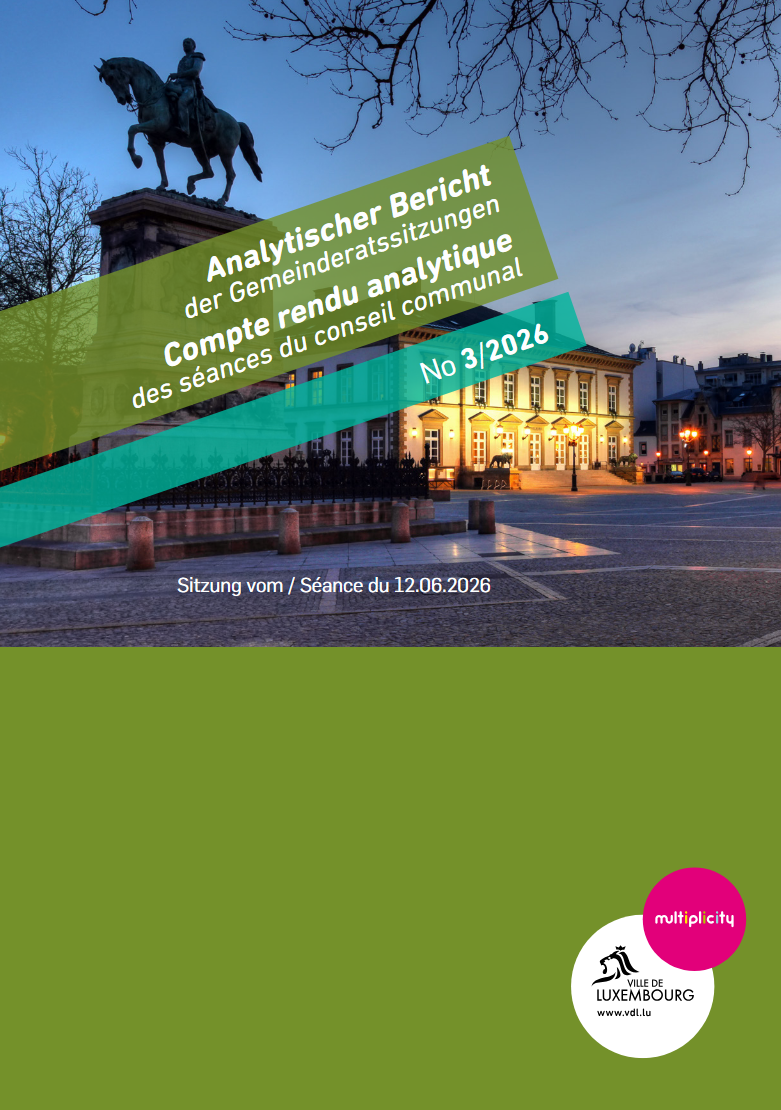
Keep reading
Questions asked by municipal councillors
Redevelopment of Rue de Stavelot and Rue des Tanneurs
Question posed by Fabricio Costa
The City of Luxembourg website explains that due to "the poor condition of the utility infrastructure in the area", the City will be implementing "a redevelopment project covering <em>Rue de Stavelot</em> in Weimerskirsch, and <em>Rue des Tanneurs</em> in Pfaffenthal. A public information session was held on 1 October 2025 in Weimerskirch."
The project will involve relocating the national cycle path, which currently runs through Laval Park, to <em>Rue de Stavelot</em>, since the current situation creates conflicts between cyclists and pedestrians. The installation of a modal filter will mean that cyclists will be able to ride along <em>Rue de Stavelot</em> in complete safety. Along <em>Rue des Tanneurs</em>, on the Weimerskirch side, the upgrade project will see the expansion of Laval Park as well as the introduction of traffic-calming measures.
In a letter dated 1 November 2025, the Pfaffenthal-Siechenhof Local Interest Association (SILPS) made several comments and recommendations regarding the City's proposed redevelopment project. As far as I am aware, it has not yet received a reply to that letter. In particular, SILPS proposed creating a gentler gradient for cyclists on <em>Rue de Stavelot</em> (the current incline exceeds the limit of 6% recommended by the Ministry of Mobility [<em>Ministère de la Mobilité</em>]), informational signs detailing the history of the site, as well as the transformation of the green space across from the Siechenhof Chapel to create an inviting space overlooking the Alzette, including benches. More generally, the SILPS proposal calls for a redesign of the parking spaces on the Pfaffenthal side, creating a form of divider between <em>Rue des Tanneurs</em> and <em>Rue de Stavelot</em>.
As the national cycle path continues towards Dommeldange, it leads onto <em>Rue Raspert</em>. As part of a motion submitted by François Benoy to the Municipal Council on 28 February 2022, it was proposed that this street should be turned into a bike-friendly route with a modal filter, given its important role connecting north and south, and the fact that it is the ideal street for such an arrangement.
- Can the College of Aldermen tell us more about the feedback received from residents during the information session on 1 October 2025? To what extent have any comments or suggestions been incorporated into the redevelopment plan for <em>Rue de Stavelot</em> and <em>Rue des Tanneurs</em>?
- Does the College of Aldermen plan to act on the recommendations and proposals put forward by SILPS? If so, what changes are planned for the redevelopment project, particularly with regard to the gradient of the cycle path on <em>Rue de Stavelot</em>?
- What is the projected total cost of the redevelopment work?
- What are the estimated start and end dates for the work?
- Regarding the proposal to convert <em>Rue Raspert</em> into a cycle route, what is the College of Aldermen's current position, and within what sort of timeframe could a potential implementation be considered?
Response provided by Alderman Patrick Goldschmidt
The works planned for <em>Rue de Stavelot</em> primarily involve the replacement of underground infrastructure. We are taking this opportunity to make some changes above ground too. At the public meeting in October 2025, neighbourhood residents welcomed the project, particularly because it will put an end to through traffic on <em>Rue de Stavelot</em>.
We were aware of the aforementioned incline, but the road is no steeper than the cycle route at Weimershof. Additionally, thanks to electric mobility, this should not pose a major obstacle.
The municipal departments have taken into account the suggestions and comments made by residents during the public meeting in October 2025. The Pfaffenthal-Siechenhof Local Interest Association (SILPS) sent a letter on this subject to the City in December 2025. We will check to see if the responses have already been sent to it.
The proposal to remove the rubbish bins has been reviewed by the <em>Service Hygiène</em> (Sanitation Department), but this option was ruled out, primarily because underground bins are not feasible due to the risk of flooding.
The <em>Service Voirie</em> (Roads Department) has also analysed the proposed construction of a raised platform in order to reduce the slope of the path running alongside the cemetery. Building such a platform would require the construction of an additional retaining wall to stabilise the new ramp. However, having a ramp of this scale would not be possible. Since the cycle path in question is a two-way national road, it must be at least 3 metres wide. A narrower path would make it impossible to guarantee vehicular access for emergency services, the CFL, and maintenance services (parks, sanitation and roads).
Barriers will be installed at the park entrance to discourage cyclists from riding through the park. Taking <em>Rue de Stavelot</em> will be the fastest route for cyclists.
Our <em>Coordination culturelle</em> (Cultural Coordination Unit) will review the proposal to install informational signs about the neighbourhood's history.
As far as <em>Rue Raspert</em> is concerned, through traffic heading towards <em>Route d'Echternach</em> has disappeared since the removal of the level crossing at Dommeldange. Once the work is complete, the City will consult with residents to find the best solution for all users.
Genital mutilation
Urgent question posed by Colette Mart
A few weeks ago, we read in the newspaper that UNICEF had released new figures on female genital mutilation (FGM), a practice that constitutes a serious violation of women's rights. According to UNICEF estimates, which are based on the number of people living in Luxembourg who come from countries where FGM is practised (based on a calculation that takes into account the proportion of women affected in those countries), approximately 2,238 women in Luxembourg may be victims of FGM, and approximately 1,000 girls and women may be at risk.
This important topic is one that I was already interested in when I was working as a journalist. When I became an alderwoman in 2011, I was informed of two cases of this kind, and we duly reported them in accordance with proper procedure. At the time, we launched initiatives with UNICEF and distributed flyers to our teaching and educational staff.
The <em>Service Médecine scolaire</em> (School Health Department) is in contact with many children from countries where, unfortunately, this practice still exists. I would like to know:
- whether the <em>Service Médecine scolaire</em> has encountered young girls who have been subjected to FGM or are at risk of it;
- if their parents are aware of and have been informed about Luxembourg laws;
- whether the victims are receiving medical care or counselling;
- if measures are in place to monitor young girls who are taken to Africa on holiday and who might be subjected to FGM;
- whether our department is affiliated with hospitals and organisations that tackle this type of child abuse;
- whether awareness-raising efforts are being undertaken among teachers and educators to ensure they remain vigilant about the dangers faced by young girls in the countries in question.
Response provided by Alderman Paul Galles
This is indeed a very important issue, and Councillor Mart's question is very pertinent because, according to UNICEF estimates, a significant number of women living in Luxembourg could be affected, even if the extrapolated nature of the figures means that we would need to look at them in greater detail.
We are fortunate to have an excellent <em>Service Médecine scolaire</em> led by a remarkable director, who ensures that all children are seen and who is very responsive. He helps children, advises parents, and takes any steps that are required.
The head of department, Ms Fandel, informed me that in the past ten years, no cases of genital mutilation have been reported among the children examined (the student population of the city's public elementary schools covers children aged 4 to 13).
School health check-ups, conducted in a standardised and regular manner, include, in particular, a clinical examination that allows for the detection of genital mutilation. Every newly arrived child in Luxembourg has a medical check-up at school within the first three months. These medical visits, conducted in the presence of the parents, also provide an opportunity to inform and raise awareness about children's fundamental rights.
If a case were to be detected, immediate care would be provided, with referral to the judicial authorities and specialised care facilities (for medical assistance and counselling).
Regular health check-ups at school help ensure continued vigilance, particularly for children who may be at risk.
The <em>Service Médecine scolaire</em> works closely with stakeholders in the health sector (doctors, hospitals), the Youth Prosecution Service, and the organisations I already mentioned to ensure a coordinated response.
It conducts prevention and awareness-raising activities for students and their teachers through our workshop on sexual and emotional education, which addresses the legal, social and ethical aspects of sexuality.
Continuing professional development is also arranged for the relevant staff (nurses, social workers). A discussion took place with UNICEF Luxembourg regarding the organisation's latest report.
The City has been committed to combating FGM since 2012. Educating the general public and City staff are objectives outlined in the 2023–2027 Municipal Action Plan for Equal Opportunities, and the City organises at least one public event each year in collaboration with local stakeholders (Padem, Fondation Follereau), such as exhibitions dedicated to the topic (at the Bierger-Center in 2023 and at <em>Place de Strasbourg</em> in 2024), cultural events ("Expression against Excision" concerts in 2013, 2015 and 2017) and film screenings followed by discussions (in 2018 and 2020). Public events including information stands are also sometimes held on <em>Place d'Armes</em>.
For 2026, the office of the City's Equal Opportunities Officer planned two events to coincide with the publication of the UNICEF study "Female Genital Mutilation in Luxembourg: Prevalence Estimates, Findings and Recommendations":
- a meeting with representatives from the <em>Service Médecine scolaire</em>, <em>Service Foyers scolaires</em> (Childcare Department), <em>Service Crèches</em> (Crèche Department) and <em>Service Intégration et besoins spécifiques</em> (Integration and Special Needs Department), during which UNICEF Luxembourg will present its study on the prevalence of FGM in Luxembourg;
- a public event organised by the association GAMS in the form of a film screening followed by a discussion (19 May 2026, at the Cercle-Cité). The evening began with a screening of the documentary "Les Puissantes", which was followed by a panel discussion featuring representatives from GAMS Luxembourg and Belgium, during which the UNICEF study was also presented.
Romanian police officers in Luxembourg City
Urgent question posed by Marie-Marthe Muller
According to an article published in Tageblatt on 17 April, two Romanian police officers will be working alongside local police as of 5 May within Luxembourg City in order to deter people from engaging in organised begging, as explained by Minister for Home Affairs Léon Gloden.
I regret that the urgent nature of my question was not recognised and that my question was not included on the agenda of the last Municipal Council meeting. It would be preferable for questions on current issues to be treated as urgent.
Meanwhile, news articles covering the most recent City Breakfast, during which the local police patrols accompanied by two Romanian police officers were discussed, show that the language issue remains a topical one. In fact, according to press reports, the mayor and deputy mayor continue to believe that the individuals being targeted to take part in organised begging are Romanian nationals, or at least speak Romanian. As for the Sinti and Roma, even if they are the ones being targeted, the ethnolinguistic issue cannot be reduced to such a simplistic, reductive, unfair and discriminatory characterisation.
- How long has the College of Aldermen been aware that two Romanian police officers are assisting their Luxembourgish colleagues in Luxembourg City?
- Would it not have been possible for the members of the Municipal Council to have been informed directly by the College of Aldermen instead of having to learn this information from the press?
- Is it true that the City has provided housing for Romanian police officers? If so, how many housing units of this type does the City currently have?
Response provided by Mayor Lydie Polfer
We had already placed this issue on the agenda for a Municipal Council meeting, which Councillor Muller was unfortunately unable to attend. The decision to have Romanian police officers accompany their Luxembourgish colleagues on patrols within Luxembourg City was made by the relevant minister, and the City supported that decision. Such a measure was already under consideration during the previous minister's term. It is important because of the language barriers. And these apply not only to the police but also to other agencies such as the staff of "À vos côtés" who want to be able to interact with people who are begging.
Minister Léon Gloden had reached an agreement with his Romanian counterpart on 5 March. The City of Luxembourg then decided to provide the Romanian police officers with two rooms in a hotel for the duration of their stay, paid for by the City and located in a district that is particularly affected by the issue. So we did not provide them with housing, but rather a hotel room.
Romanian police officers are simply accompanying their Luxembourgish colleagues and assisting them whenever language barriers arise. A final assessment of this approach will reveal how well has worked in practice. It is an approach that could perhaps be extended to other languages, since the language barrier does not just affect people of one nationality.
CSL advertisements in City magazine and at bus shelters
Question posed by David Wagner
I have heard that the College of Aldermen refused to let an advertisement from the Chamber of Employees (CSL) be published in <em>City</em> magazine. It was an ad in which the CSL advocates for tax reform. According to CSL representatives, the publishing house in question reportedly told them that the City had refused to allow publication.
- Can the College of Aldermen confirm the allegations that the City intervened in some way, whether through the editorial board or not, to prevent the publication of this advertisement?
- If so, can the College of Aldermen explain the reasons for this refusal?
- If it is not the case, can the College of Aldermen assure us that the advertisement will soon be published in <em>City</em> magazine?
In the same vein, representatives from the CSL also informed us that JCDecaux had notified the CSL that it could no longer display the campaign on bus shelters in Luxembourg City. JCDecaux had removed the posters after two or three days. Although JCDecaux is independent of the City of Luxembourg, the fact that these two decisions were made at the same time raises questions. Did the City take any action, in any way, to have JCDecaux remove the CSL posters from the bus shelters?
Response provided by Mayor Lydie Polfer
The terms and conditions for <em>City</em> magazine stipulate that the agency under contract "will ensure that advertisers are selected in accordance with the magazine's editorial charter and the City's values. Advertisements with political themes or content, including any form of promotion related to political or social elections, are prohibited."
Clear criteria also apply to advertisements displayed by JCDecaux. The rules state that "the advertisement must not be of a political or religious nature, nor contrary to public decency."
In both cases, the criteria are therefore clear and precise, and in the case of advertising through JCDecaux, the political party to which Councillor Benoy belongs actually helped outline these criteria.
It is possible that an ad that did not meet these criteria might have slipped through the cracks in the past.
During a previous term of the College of Aldermen, we rejected a request concerning religious advertisements, based on the afore-mentioned criteria. I will look into whether an advertisement from a professional association has been published or rejected in the past.
Advertisements in City magazine and at bus shelters
Question posed by François Benoy
According to my information, the City of Luxembourg, or rather its subcontractors, recently rejected an advertisement from the Chamber of Employees in <em>City</em> magazine as well as a poster campaign at bus stops.
- Can the College of Aldermen confirm this information? If it is correct, what were the reasons?
- Have there been any ads or posters from professional associations in <em>City</em> magazine or at bus stops in the past? If applicable, were any rejected, and if so, on what grounds?
If you leaf through the latest issue of City magazine, you will find, alongside institutional and cultural organisations, ads from real estate agencies and insurance companies, as well as events taking place outside the city. At bus shelters, the range is much broader, and I also remember some advertisements that were sexist in character or ran counter to climate goals.
- Given that there are often uncertainties regarding advertisements displayed on the City's media, are there specific criteria applied in this regard? If not, does the College of Aldermen plan to establish such criteria? If yes, could you please elaborate?
Response provided by Mayor Lydie Polfer
The terms and conditions for <em>City</em> magazine stipulate that the agency under contract "will ensure that advertisers are selected in accordance with the magazine's editorial charter and the City's values. Advertisements with political themes or content, including any form of promotion related to political or social elections, are prohibited."
Clear criteria also apply to advertisements displayed by JCDecaux. The rules state that "the advertisement must not be of a political or religious nature, nor contrary to public decency."
In both cases, the criteria are therefore clear and precise, and in the case of advertising through JCDecaux, the political party to which Councillor Benoy belongs actually helped outline these criteria.
It is possible that an ad that did not meet these criteria might have slipped through the cracks in the past.
During a previous term of the College of Aldermen, we rejected a request concerning religious advertisements, based on the afore-mentioned criteria. I will look into whether an advertisement from a professional association has been published or rejected in the past.