Taking action to build tomorrow's city together
Climate change poses a monumental challenge for our society. Luxembourg City intends to face that challenge with ambition, responsibility and pragmatism, to ensure our city is as well prepared as it possibly can be for the future.
With this in mind, the City is beginning to put together its official Climate Plan. As a comprehensive strategy for the coming years, this plan will outline actions to reduce greenhouse gas emissions and accelerate the energy transition, hinging on four key objectives:
- Reducing greenhouse gas emissions
- Reducing dependence on fossil fuels
- Strengthening the city's resilience
- Improving air quality
A plan designed to benefit all!





A collective effort bringing tangible benefits
We can only protect the climate by working together.
This is why the City is involving all local stakeholders in this initiative: municipal departments, businesses, public institutions and the general public.
To develop a plan that is both ambitious and tailored to suit the reality on the ground, we are organising various consultation processes throughout the project:
- Thematic workshops with municipal departments
- Public consultation
- Citizen dialogue in the form of one-to-one interviews with owners of residential buildings in the city with significant potential to reduce their climate impact.
- Targeted consultation with businesses and economic stakeholders operating in the city
- Close collaboration with public institutions






A long-standing commitment
Luxembourg City has been actively committed to protecting the climate and bringing about the energy transition for many years.
This commitment forms part of the Climate Pact, under which it received its "European Energy Award Gold" certification in 2025, and is in line with the Leitbild Klimaschutz adopted in 2017 and updated in 2023.
This policy document sets out several goals to be achieved by 2030, both within Luxembourg City and for the City of Luxembourg administration:
- Cut CO₂ emissions by 55% compared with 2014;
- Improve energy efficiency by 44%;
- Increase the share of renewable energies to 37% of total energy consumption.
Over and above these goals, the City is aiming to achieve carbon neutrality by 2050. Acknowledging its place as a leader, the City authorities have set an even more ambitious goal for their own operations and assets – namely to achieve carbon neutrality by 2040.
The College of Aldermen has also reaffirmed its commitment in its mission statement for 2023–2029, making adaptation to climate change and the energy transition its key priorities.
With this in mind, the City is beginning to put together its Climate Plan as a way of coordinating and strengthening the efforts that have been under way for quite some time.
Steps in the project
The development of the Climate Plan involves several steps:
- Adapting the assessment of the current situation to the national methodology;
- Forecasting future scenarios;
- Identifying opportunities to reduce energy consumption and carbon emissions;
- Defining an action plan.
This will enable us to develop a strategy tailored to local realities and the challenges the city faces.
Carbon emissions
The first step of the Climate Plan was to review our carbon footprint, aiming to bring it into line with national and international standards. The Climate Plan distinguishes between two areas of analysis: the carbon footprint of Luxembourg City as a whole and the carbon footprint of the City of Luxembourg administration.
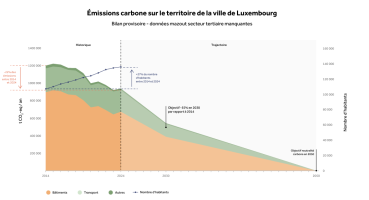

While the population of Luxembourg City grew significantly between 2014 and 2024, carbon emissions were substantially reduced during the same period. Meeting climate goals remains a major challenge, but this encouraging trend confirms that we are moving in the right direction.
Since the construction and transport sectors are among the leading emitters of greenhouse gases, the action plan will pay particular attention to these areas and focus efforts on reducing their emissions.