Territory
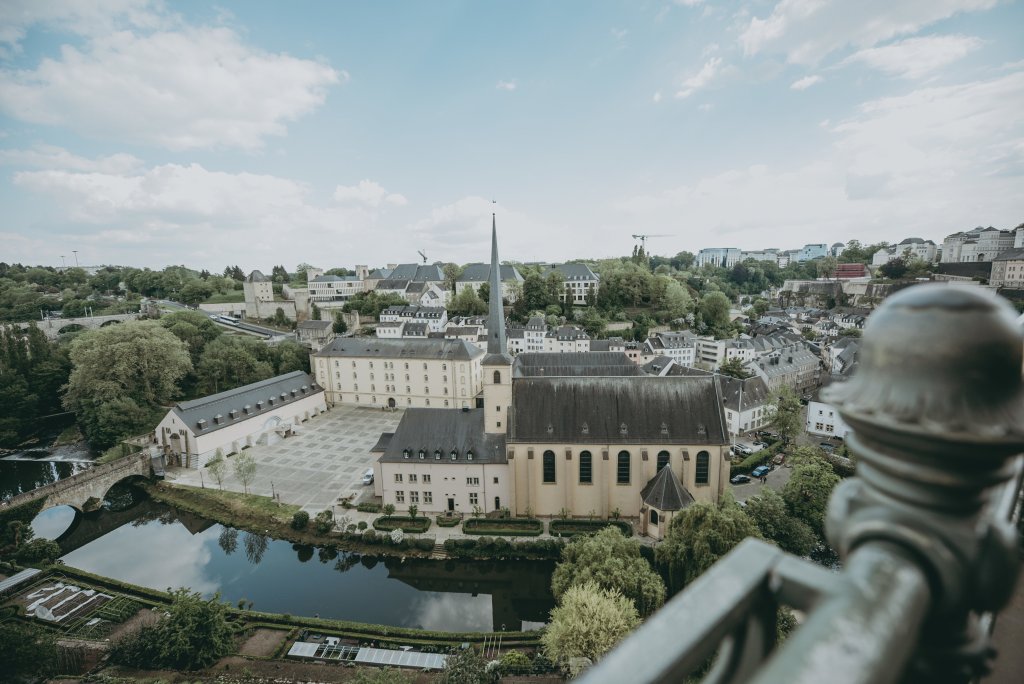
Luxembourg City has an area of 51.73 km², making up about 2% of the nation's territory. It has a circumference of 52.5 km.
Other figures:
- 30% of the city is covered by buildings;
- 27.7% of the city is covered by agriculture;
- 22% of the city is covered by forest;
- 8.7% of the city is covered by streets and squares;
- 1.5% of the city is covered by industrial facilities;
- 0.7% of the city is covered by waterways.
Luxembourg City is located at 49°36'36"N, 6°7'40"E. Its altitude ranges from 232 m (Beggen, Rue de Bastogne) to 408 m (Dommeldange plateau), and is 304 m in the city centre (Place d'Armes).
The average temperature is 9.0°C (measured in Findel).
Population matters
Total population (as at 31 December 2025): 137,696 inhabitants
- Luxembourg nationals: 42,020 (30.52 %)
- Foreign nationals: 95,676 (69.48 %)
Distances to cities in neighbouring countries
Having borders with Belgium, France and Germany, Luxembourg is in the heart of Europe:
| France | Germany | Belgium |
|---|---|---|
|
Metz: 60 km |
Trier: 48 km |
Liège: 168 km |
|
Strasbourg: 222 km |
Saarbrücken: 100 km |
Brussels: 225 km |
|
Paris: 370 km |
Cologne: 197 km |
Anvers: 254 km |
Motorway network
Six motorways directly connect the capital to these neighbouring cities:
- the A1 to Cologne and Frankfurt;
- the A13 to Strasbourg and Saarbrücken;
- the A3 to Metz, Nancy and Paris;
- the A4 to Esch-sur-Alzette;
- the A6 to Namur, Brussels, Liège and Maastricht;
- the A7 to Aachen;
City staff
To be able to properly provide for its residents, the City of Luxembourg has around fifty administrative, technical, cultural, social and socio-educational departments.
| Status | Women | Men | Total |
|---|---|---|---|
| City employees | 37 | 23 | 60 |
| Civil servants | 488 | 1,244 | 1,732 |
| Employees (formerly "employés privés") | 736 | 455 | 1,191 |
| Employees (formerly "ouvriers") | 587 | 1,096 | 1,683 |
| TOTAL | 1,848 | 2,818 | 4,666 |
Service Autobus
The fleet
The AVL fleet is made up of 72 standard buses (52 of which are electric) and 58 articulated buses (20 of which are electric).
As part of the transition to electric mobility, AVL expects to take delivery of several electric vehicles in the near future, including: 42 articulated buses and 14 standard buses in 2026, and 15 standard buses in 2027.
In parallel, subcontractors operate 160 electric buses, including 72 standard buses, 84 articulated buses, and 4 midibuses.