Overview
A rich history spanning over 150 years
The departure of the first horse-drawn tram from Luxembourg Central Station in February 1875 marked the beginning of a rich and ever-evolving story: that of public transport in Luxembourg. Since then, new modes of transport have continued to emerge, keeping pace with the city's continued growth and changing needs.
Over the decades, these developments have profoundly shaped the urban landscape, fostering the emergence of new neighbourhoods and reconfiguring the connections between different living spaces. This exhibition invites you to explore how public transport – which is much more than just a means of getting around – has played a role in shaping and transforming Luxembourg from past to present.
The arrival of the "Päerdstram"
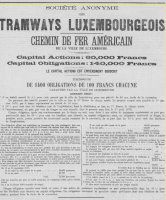
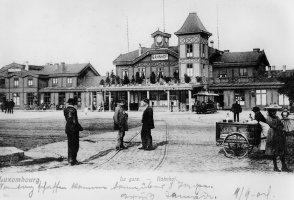
With the signing of the Treaty of London in 1867 and the subsequent dismantling of the fortress, the city was able to open up and expand into new areas. In terms of mobility, it took just eight years for the city to introduce a new modern means of transport: the horse-drawn tram, or "Päerdstram", as it was known in Luxembourg. In 1874, the City of Luxembourg's Municipal Council commissioned Charles de Féral, a Luxembourg engineer, to carry out this project. The first line, which connected the train station to the Athénéee, was inaugurated on 21 February 1875.
The tram met the need to provide transport to and channel large numbers of people, and it was at the heart of the so-called three Ts – train, tram & trottoir, or "train, tram and pavement" in French – which characterised the development of public spaces at the time.
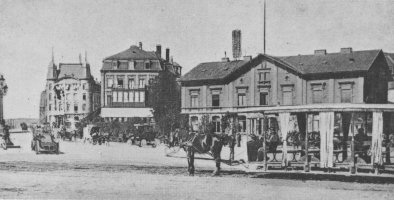
That same year, the line was extended to Champ du Glacis, just in time for the opening of the Schueberfouer – something that would repeat itself 143 years later. The depot, known as "Tramschapp", was located across the street from the train station on Rue Joseph Junck. It held the vehicles, a stable that could accommodate 50 horses, and the attached forge.


The tramway and the urban development of the city
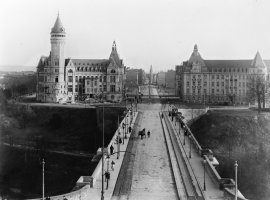
Luxembourg City's urban development was closely linked to the development of the tram. The concentric zone model adopted on the former west side of the fortress sought to make the centre more densely populated while connecting the city to its outskirts. The straight avenues were designed to accommodate this mode of transport, and Pont Adolphe was planned in anticipation of having the tram pass over it. Crossing the city from south to north, the tram became a defining feature.
Investment in the tram reflected a strong political desire to guide urban expansion. With the city walls gone, this helped prevent unstructured urban sprawl. The venture was backed by public and private stakeholders, including influential figures in local urban planning, who saw it as a way to give the city a lasting structure.
Outskirts and centre come together
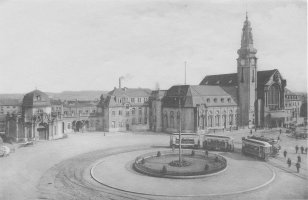
The tram quickly connected the city centre to the outskirts, facilitating travel between residential and working areas. The central train station became a major modal platform connecting trains, trams, stagecoaches and automobiles. This integrated network galvanised the economy and helped make the city more accessible.


Goodbye, "Päerdstram"; hello, electric tram!
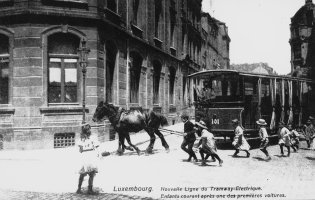
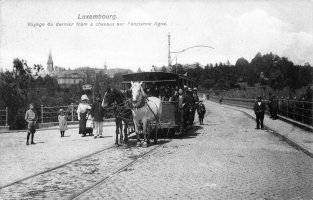
Transport consisted of two types of vehicles, both of them horse-drawn: summer carriages, which were open, and winter carriages, which had windows and wooden roofs.
But not everyone was happy to have the horse-drawn tram on the streets – quite the opposite, in fact. In the early 20th century, the City found itself fielding more and more complaints about horse manure, even though there were workers whose job it was to clean the roads.
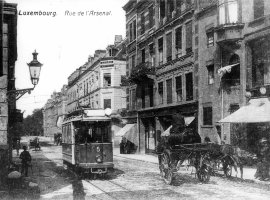
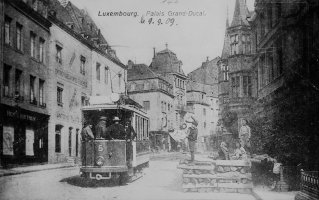
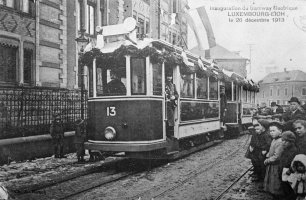
The electrification of the tram network in 1908 made this problem a thing of the past. With this came another major change, as the track switched from the standard-gauge railway (1,435 mm) to the narrow-gauge railway (1,000 mm).
At the same time, new electrically driveable vehicles were purchased, and the old cars were updated to operate as trailers.


The rise of the electric tram
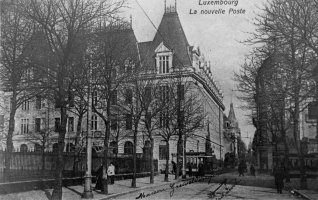
New districts incorporated into the city in 1920 were also connected to the tram network. This occurred in the following years: Beggen (1922), Neudorf and Hollerich (1923), Bonnevoie (1924), Merl (1926) and Rollingergrund (1929). The tram's arrival in Heisdorf in 1930 marked the expansion of the network beyond the capital's borders.
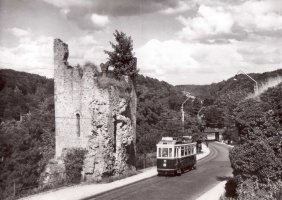
The claim to fame of the Neudorf line was that it ran on Montée de Clausen: with a 10% gradient, this section was considered one of the 10 steepest railway slopes in the world. Of course, the tram made the descent slowly, moving at 6 km/h.
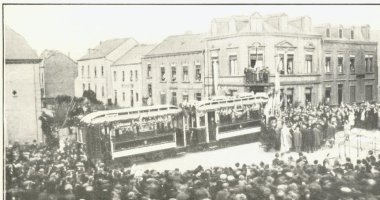
Celebrations accompanied the inauguration of every new stop. Enthusiastic residents would welcome the tram with a parade.
To improve traffic flow at the train station, a turnaround loop – nicknamed the "racket" due to its shape – was created in 1923.
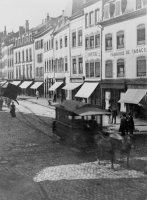
After the tram was electrified in 1908, the network was extended to Limpertsberg, Bonnevoie and Hollerich. Schools, hospitals and cinemas opened near the stops. Crossing public thoroughfares, the tram glided in front of businesses, whose window displays were on full view to travellers. The tram also started to be used for advertising, in the form of posters.
The network, which was becoming more and more dense, was organised into loops and branchbranch lines. It defined the areas for urban development and played a role in social and spatial planning. The extension of the network thus went hand in hand with housing policies, enabling populations to settle in the outskirts of the city while remaining connected to the centre. The tram transformed the perception of distance: it was now measured in travel time rather than in kilometres or the amount of physical effort required. It influenced the real estate market and residential choices, particularly among the middle classes. It introduced new spaces for social interaction: the stops became meeting places, incorporated into local business life, with tickets also available to buy in local shops.
While the tram supported social cohesion, it still reflected certain forms of exclusion, as access rules and class differences in the cars reflected the social hierarchies of the era.


1925: The introduction of numbering
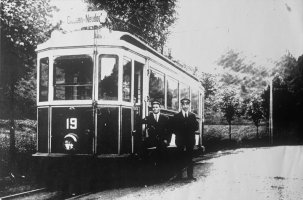
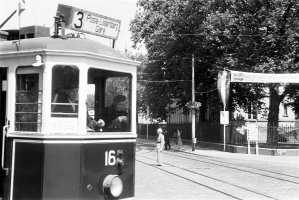
In 1924, the system had a total of eight lines offering 13 combinations of different journeys, but only four of the lines had names. There were designations by colour ("yellow line", "red line", etc.) and by district names ("Hollerich line").
This situation, which was hardly ideal for customers, prompted the creation of a numbering system, which took effect on 1 January 1925. Lines 9 (Neudorf) and 10 (Beggen) were then transferred to the bus network, and to this day they continue to operate in this form.
By 1930, the tram system reached its maximum length – 31 kilometres – and had transported 8.2 million passengers, a record for this period.


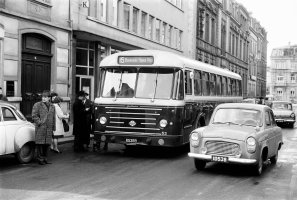
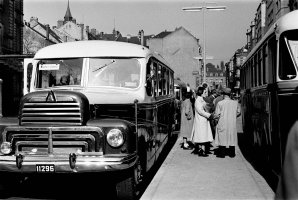
1926: Introduction of the first buses
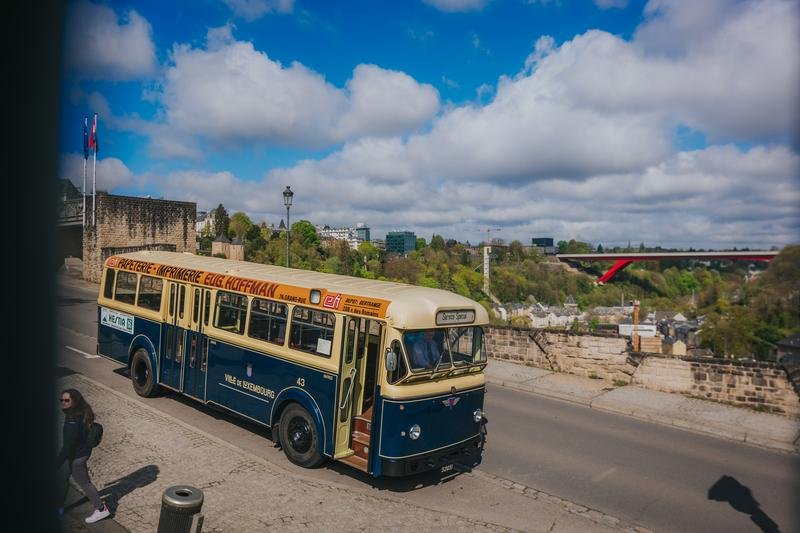
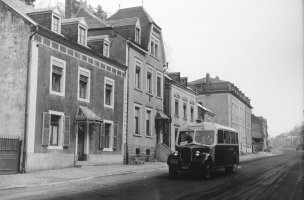
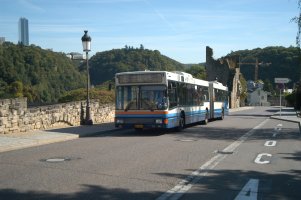
The first buses began operating in 1926. With this new addition, hard-to-reach districts, such as Hamm and the Grund, could be easily served, as well as districts that were still under development, such as Gasperich. With regard to the latter, the ability to alter routes at any time proved to be a great advantage.
In terms of design, the new buses were dark blue, echoing the tram's colour scheme. Much later – 91 years, to be exact – this relationship was reversed when the tram adopted the coloured doors inspired by the "Multiplicity" design of the municipal buses.


The tram service comes to an end (for a while)
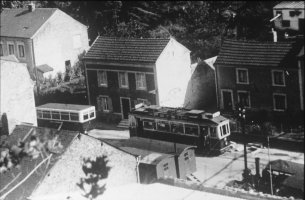
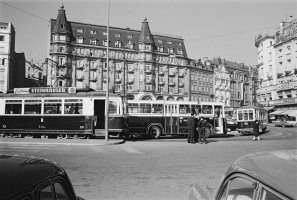
From the 1950s and 1960s onwards, car ownership became more widespread. Meanwhile, the tram had a hard time making its way through streets that were growing more congested, forced as it was to share a lane with private vehicles. This "old" mode of transport was increasingly being seen as something with no future. Over time, several lines were replaced by buses.
On 5 September 1964, the last tram service came to a halt – at least for a while. With a parade in which even the old horse-drawn tram received a final tribute, line 10 was decommissioned.
In 1953, a German civil engineer named Max Erich Feuchtinger had presented an urban development plan that focused on the automobile to the detriment of the tram, in keeping with the trends of the time.


50 Joer Bouillon
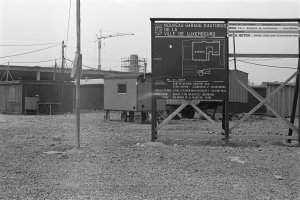
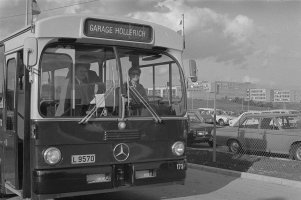
The Service Autobus, or City of Luxembourg Bus Department, was housed in the former "Tramschapp" in Limpertsberg. This space became less suitable as the fleet continued to grow, prompting the City to build a new depot on Rue de Bouillon in Hollerich.
The result was the new Garage Hollerich, which was commissioned in 1975. This site had a service hall, repair shops and body shops, a cleaning platform and an administrative building.
In 1991, the Tram and Bus Museum opened its doors in Hollerich to mark the 65th anniversary of the introduction of buses.


E Kuss fir de Bus
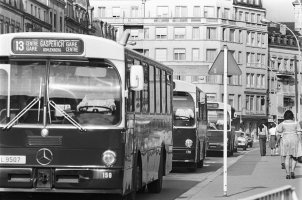
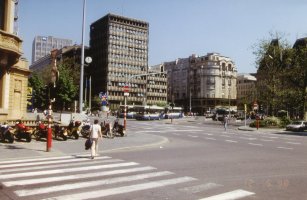
In the 1980s, faced with the threat of increasing traffic congestion, municipal officials realised that public transport needed to be made more appealing to residents. As a result, from 15 September 1982 onwards, some urban bus lines were extended beyond the city limits to also serve the outlying municipalities and reach large numbers of commuters. In 1983, the municipality enlisted the help of Heinrich Brändli, a Swiss transport expert. His study led to the implementation of the "Brändli concept", with the following main characteristics:
- Extensive local availability – in other words, a dense network with short distances to the closest stop;
- A fixed schedule with the shortest waiting times possible – in other words, high frequencies on all the main lines;
- The implementation of bus lanes and introduction of special traffic light signals giving buses priority.


The tram returns to Luxembourg City
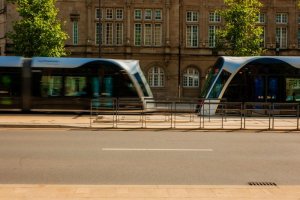
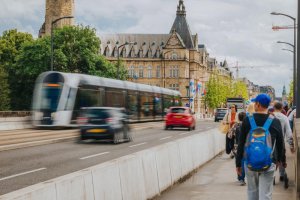
The law on the construction of a tram line between the train station and Luxexpo was passed on 4 June 2014.
Under the slogan "Good Morning Mobilitéit", the new tram was inaugurated in the middle of a heavy snowstorm at a ceremony attended by the Grand Ducal couple on 10 December 2017 – 25 years after the plans for it were first unveiled.
That same day, the Howald and Pfaffenthal-Kirchberg train stations began operating. A new mode of transport that had never existed before in Luxembourg was also inaugurated: the Pfaffenthal funicular.
After the last tram lines were taken out of service in 1964, the return of the tram in 2017 formed part of a far-reaching integrated mobility project encompassing train stations on the city's outskirts, park-and-ride facilities, bus networks and cycle lanes. This modern vision was reminiscent of the historical significance of Luxembourg City's tram system after the fortress was demolished in 1867.
A French-style tram?
The project owners – the Luxembourg government and the City – decided to implement this project on the basis of a French-style tram system. Indeed, tram projects and concepts had set a precedent in France in the past:
- the implementation of this new mode of transport needed to be linked with an urban redevelopment initiative;
- the vehicles needed to be able to accommodate a large number of passengers;
- the timetable needed to ensure a frequent, attractive service, with a maximum wait time of five minutes;
- the route needed to be designed in a way that would allow the tram to run on a separate track.
In keeping with this philosophy, it was decided that the tram should be considered as a symbol of the city, meaning that it was given its own special design concept.



An interconnected, multimodal network
The tram is not in competition with buses – quite the opposite! The tram is now part of a system in which each mode of transport has its own purpose:
- the railway (CFL) is for national and international connections;
- the regional buses (RGTR) are for intercity and regional connections;
- the tram is the "backbone", providing connections between the city's major hubs (Kirchberg, city centre, Gare, Cloche d'Or);
- the bus is for interdistrict connections;
- these modes of transport are supplemented by the Pfaffenthal funicular and the Pfaffenthal and Grund elevators.
The various modes of transport are connected by transport hubs.
Let's go electric!
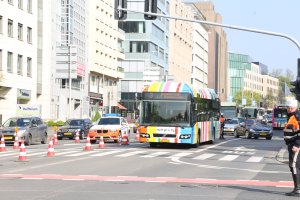
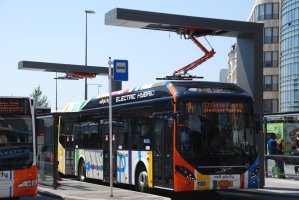
In 2026, Luxembourg City will become one of the first cities in Europe to have electrified its entire bus fleet. This means that all of its buses will now be fully electric.
This major milestone in the history of the City Bus Department marks the logical continuation of a philosophy that has always aspired to be at the cutting edge of innovation. It is in this spirit that the City of Luxembourg has experimented with alternatively powered vehicles:
- buses running on biodiesel (rapeseed oil fuel) in the 1990s;
- buses equipped with fuel cells (operating on hydrogen) in the early 2000s;
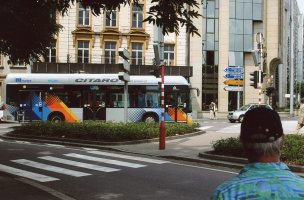
- the first hybrid technology buses, then plug-in hybrids, starting in 2011.
Free transport and electrification
Making public transport free and electrifying the fleet are initiatives that fulfil the United Nations' Sustainable Development Goal 11: "Make cities and human settlements inclusive, safe, resilient and sustainable".


Outro
From the horse-drawn "Päerdstram" to the modern tramway and fully electric buses, Luxembourg City's public transport has continually reinvented itself to meet the challenges of the day. As a reflection of technological, urban planning and societal changes, it has accompanied the city's growth while bringing its residents closer together.
Today, the mobility network is more than just a means of getting around – it embodies a forward-looking vision that is sustainable, interconnected and synergistic. And while this story already spans more than 150 years, it continues to be written every day, shaped by innovation and the mobility needs of tomorrow.