Strategic development policy
The strategic development policy for the City of Luxembourg's Service Autobus (Bus Department – AVL) is driven by several factors (see below), all of which are geared towards achieving one key outcome – user satisfaction:
- a streamlined, reliable, attractive bus network serving all Luxembourg City districts, with inter-district connections with as few changes as possible, easy connections to outlying districts, and frequent and punctual services
- streamlined, user-oriented digital services
- clear information for users to help them choose the most suitable mobility options
- a fleet of high-performance, state-of-the-art vehicles
- the transition to e-mobility, which is more comfortable, cleaner, and quieter
- well-trained staff who are committed to their jobs
- safety, for both transport users and AVL staff
- a continuous improvement process, providing for regular adjustments to the network in line with users' changing needs
- the department's active contribution to municipal and national mobility plans
- cooperation with various public transport stakeholders to further enhance the City's bus network and interconnections with other networks (most notably CFL, Luxtram and RGTR)
- guaranteed access to public transport services for persons with reduced mobility (PRM)
The primary aim of this policy is to meet users' expectations by continually adapting the network to suit their needs and accommodate external developments. It also seeks to guarantee that the city remains accessible in the long term, and to respond to environmental challenges by offering effective, sustainable, forward-looking urban mobility options. Technological advances are continually taken into account and incorporated with a view to providing a modern, cutting-edge service.
Accomplishments and projects
The AVL has launched several projects in recent years, and is also working on a number of new initiatives
E-mobility
In 2017, the City of Luxembourg began installing charging infrastructure at several bus line terminuses. Eight charging stations are now fully operational, along with 30 charging points at the AVL depot in Hollerich.
In 2019, the City decided to electrify its entire bus network, phase out its diesel buses, and purchase full-electric buses. In 2022, a tender process for subcontractors was launched, requiring the use of full-electric vehicles.
A further 57 electric buses are scheduled to be delivered by the end of this year. By the end of 2026, 95% of vehicles in the City of Luxembourg bus network will be electric. An additional 15 electric buses are scheduled for delivery in 2027, thereby completing the transition from diesel to full-electric mobility.
Since the start of the network electrification process, CO₂ emissions have fallen significantly, demonstrating the positive impact of this transition to a more sustainable form of mobility. In 2016, before the City began electrifying the network, buses operated by AVL and its subcontractors emitted 15,600 tonnes of CO₂, which accounted for 38% of all emissions from municipal activities (vehicles, administrative buildings, technical infrastructure, etc.). By the time the electrification process is completed, practically all of these emissions will have been eliminated.
Installation of a Depot Management System with geolocation features
The AVL is currently installing electric bus management software at the depot in Hollerich. The software will be used to manage overnight charging of electric buses, oversee vehicle parking, and further automate this process. To boost the performance of the "Depot Management System", the AVL also plans to install a highly accurate geolocation system at the Hollerich depot.
CCTV on buses
In 2022, the City of Luxembourg decided to install CCTV on board all its buses. Today, practically all buses in the City's network have been fitted with CCTV cameras, enhancing passenger safety. The final phase of deployment – involving 5% of the buses in the fleet – is scheduled for 2027.
Improved mobile app services
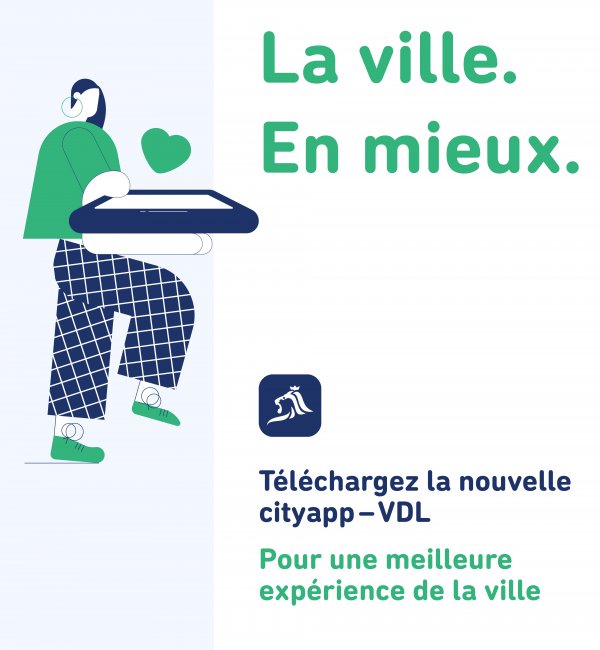
The AVL continues to contribute to the development of the City's mobile app, which is designed to help users navigate the city's public transport services. In fact, as of today, "cityApp – VDL" incorporates a new routefinder feature. Based on Mobiliteit.lu data, it enables users to plan their public transport journeys through a simple, easy-to-understand, customisable interface, and to save their favourite addresses for quicker access. It complements already available real-time information, and provides users with additional support in their day-to-day use of the City's public transport services.
Digitisation of bus shelters and new digital displays at all stops
More than 300 bus shelters in Luxembourg City have been fitted with digital displays in recent years. In the medium term, the City plans to scale up the digitisation of its infrastructure, and to install digital displays at stops with no shelter. This will eliminate the need for paper displays, and provide a means to display real-time bus departures, information on temporary changes within the network, and other user information, quickly and easily across the entire network.
Participation in uni.lu's ATLAS research project
In 2025, as part of the University of Luxembourg-coordinated interdisciplinary research project ATLAS (Autonomous Systems for Land, Air and Space) – which involves developing intelligent autonomous systems for various mobility-related fields, with specific focus on sustainable mobility, cybersecurity, artificial intelligence, and robotics – the AVL took on a doctoral student whose research focuses on urban mobility. Through its participation in this project, the AVL hopes to optimise certain daily operations – scheduling, vehicle charging, maintenance, parking, etc. – and reduce certain costs by creating digital twins of its operations, driven by machine learning. Additionally, data on electric buses' energy consumption that are collected and analysed as part of the project can be used to develop smart charging strategies, and thus support the energy transition. Lastly, through its participation in the ATLAS project, the City Luxembourg has reinforced its position as a key player in the field of smart sustainable mobility, benefitting from advanced analytical methods through its access to scientific expertise, and helping to train future experts in urban mobility.
New AVL depot
In anticipation of the planned replacement of the AVL depot in Hollerich (built almost 50 years ago), a working group is currently designing a new building that would not only meet current operational requirements, but also be fully compatible with future technologies.
Autonomous buses
The AVL constantly monitors and analyses advances and developments in the autonomous bus market, with a view to assessing the extent to which the technology could serve the department's needs. Ultimately, the aim is to acquire such buses, which can navigate automatically around the AVL's future depot.