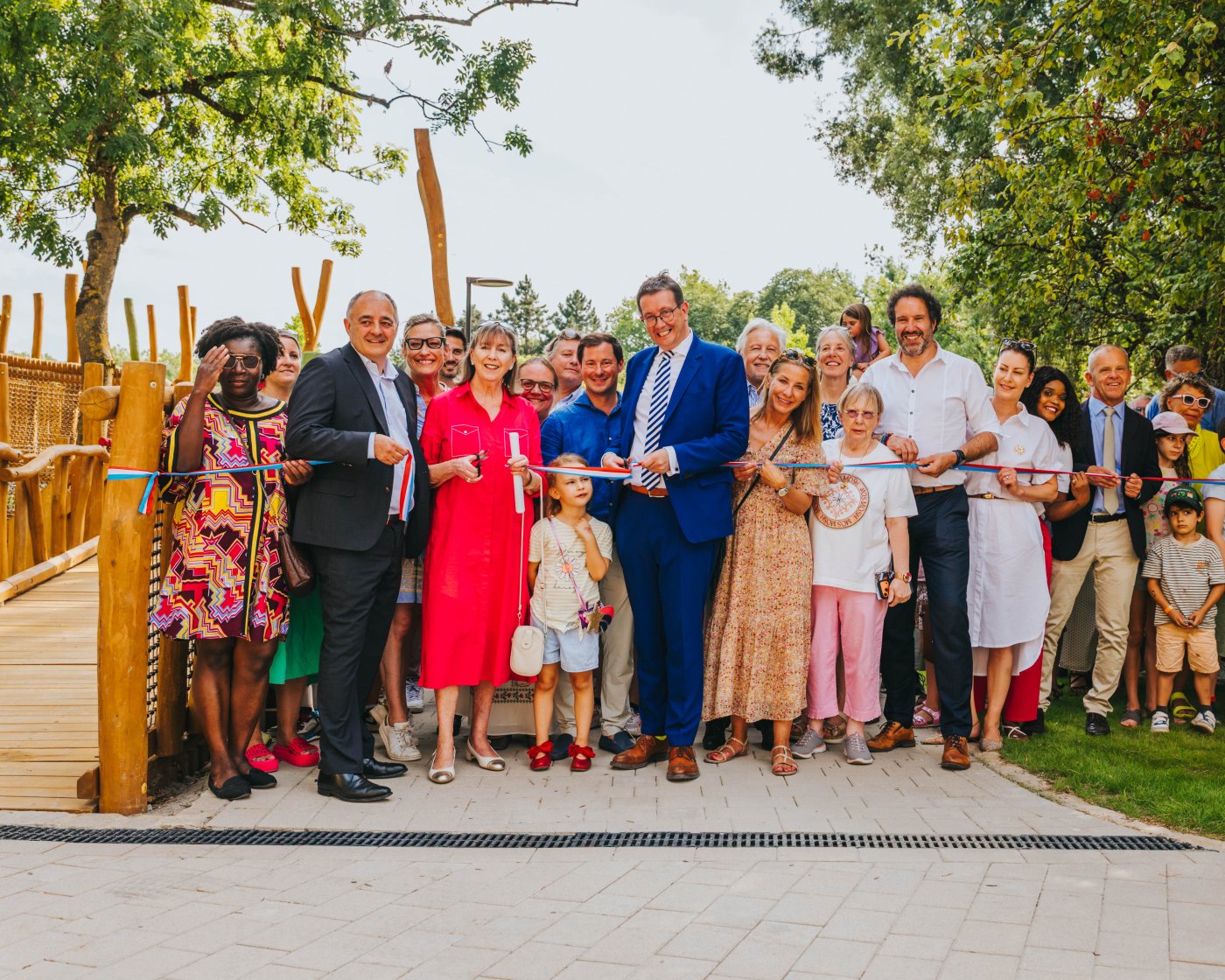
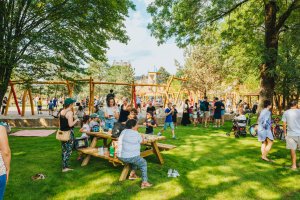
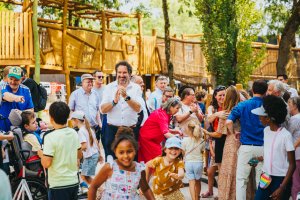
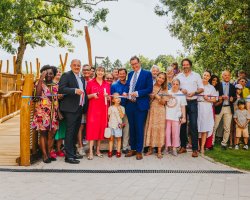
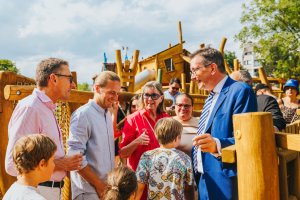
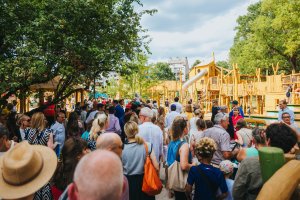
Official opening – Playground in Merl Park


Background
In response to growing visitor numbers, the playground in Merl Park had seen the installation of new equipment over time, ultimately becoming a sort of disconnected mosaic of installations, and the basic concept around which it was originally designed had been lost along the way. Aware of the importance of play areas for children's quality of life and development, the College of Aldermen decided to build a new, fully inclusive playground, designed around a cohesive concept that provides for many play options and meets the needs of children of all ages.
In 2021, an online survey was sent out to residents to garner opinions. In addition, on the actual site, information boards were installed, along with a suggestion box for visitors – particularly children – to put forward their ideas. With this participative approach, residents were able to have direct input into the design of this public space.
The first design that was presented did not fully meet the local residents' and users' expectations, so the College of Aldermen organised meetings with their representatives to take their comments and concerns on board. In spring 2024, the project was reworked and refined to take account of the recommendations that came out of those exchanges. The redesigned version of the playground met with residents' approval, so wheels were set in motion to have the work carried out.
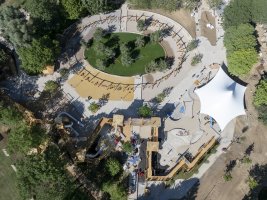


Description
Concept
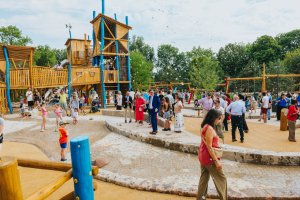
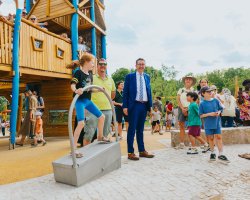
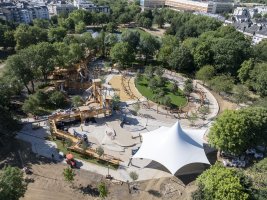
Inclusivity and accessibility are at the heart of the "Märeler Park" playground, designed by the firm Schwarze und Partner Landschaftsarchitekten and built by SIK-Holzgestaltungs GmbH and Sopinor Constructions. The playground has specially adapted equipment so wheelchair users can partake fully and play alongside other children, making for moments of shared play, social interaction and participation by all. Designed with different areas, the playground offers children new experiences that are both fun and educational, through varied types of play.
Play areas
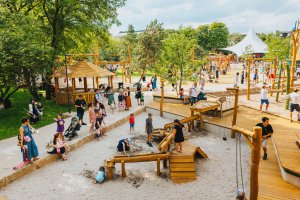
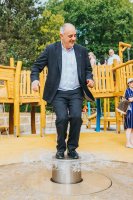
On the northern side of the playground there is a versatile, spacious water play area, measuring 900 m2. Platforms and ramps make up the basic structure, while in the centre there are water and sand-based play equipment such as water sources, pumps, spirals, sieves, fountains, tubes and channels that entice children to explore and experiment. This equipment offers children hands-on experience of how water behaves (fluid dynamics), and lets them explore the features of waterways. A wide array of water games are designed to encourage social interaction and get children talking, playing and working together, while the different pumping mechanisms allow them to practise their motor skills. The materials used on the ground – stone, sand and shock-absorbing aggregate – create a barefoot-friendly surface for a unique sensory experience. The barrier-free design of the water play area makes for a space that welcomes all visitors, regardless of age or ability.
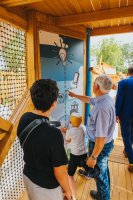
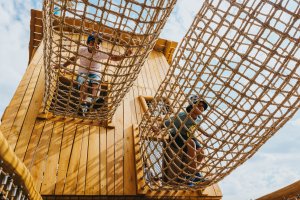
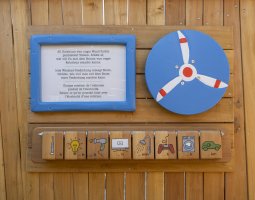
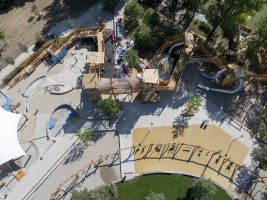
Outside the water area, there is an entrance ramp that people with reduced mobility can use to access the main structure of platforms and connecting structures extending from the northwest to the southeast of the playground. Two high towers – one representing a hydroelectric power plant and the other a wind turbine – are central to the structure and shape the image of the park and the playground. In addition to giving children lots of places to climb and explore, there are sensory and educational games on the inside of the towers, focusing on hydroelectric and wind power. The towers are linked by the accessible walkway, which runs across the entire structure, as well as having individual access points. In addition, rope tunnels connect the upper floors of the two towers, and there is also a slide. This part of the playground offers an engaging combination, bringing together games, learning and discovery while teaching children in a fun way about the importance of renewable energies and sustainability.
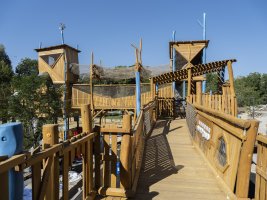
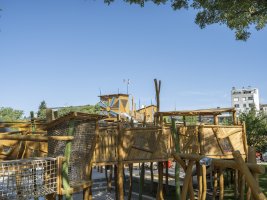
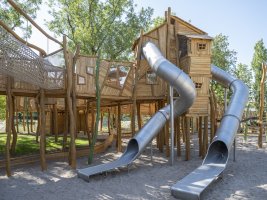
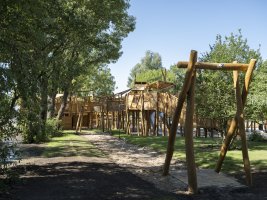


A climbing route, spanned by the accessible walkway, extends from the two main towers towards the southeast side of the playground. The walkway, which has a maximum height of around 3.80 metres, has barriers on the sides with openings secured by netting or plexiglass so that children have a commanding view of the entire playground. Two smaller towers with tube slides feature in this area, which also includes suspended walkways and balance games, nets and climbing walls. This variety of games helps to develop children's agility, stamina and coordination. The walkway leads to different platforms and tiers where children of all ages can play and gather. Rope tunnels connect different parts of the walkway, creating alternative paths that help improve traffic flow while making children's experience more varied and dynamic. Thus, children can choose between different routes, stimulating their creativity and helping prevent congestion. Sensory components placed on the walls of the towers and along the walkway provide additional games and entertainment. Where the structure is high enough, games are placed under the walkway to maximise use of the space and to provide additional and shaded play areas.
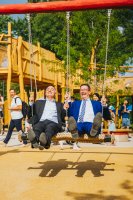
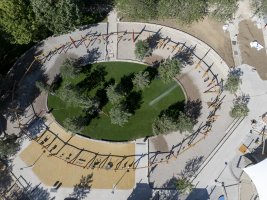
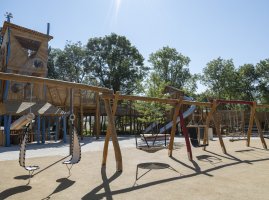
The southern part of the playground features a large oval-shaped structure containing swings arranged around a central green space. This installation includes a broad array of different types of swings – conventional swings, nest swings, two-person swings, infant swings, hammocks, topped off by inclusive swings designed specially for people with special needs. The oval shape creates a unique play experience in which children can watch one another, fostering a sense of community and shared fun. The ground is covered in sand, gravel and shock-absorbing aggregates to keep children safe. The oval arrangement of the structure also allows parents to keep an eye on their children at all times.

Materials
In keeping with the desire to be eco-friendly, the structures are made of robinia sourced from sustainably grown trees. Known for its natural durability and resistance, this wood is especially well suited for playgrounds; it requires little maintenance, and robinia-built installations are very long-lasting.
The materials used on the ground – stone, sand and shock-absorbing aggregate – create a barefoot-friendly surface for a unique sensory experience.
Public safety
Like all other playgrounds in Luxembourg City, the Merl Park playground adheres to all current safety standards. It has also been inspected by LuxControl s.a., which assesses the safety and proper functioning of playgrounds and issues the "Sécher Spillplaz" label as a quality guarantee.
Surface areas
The playground extends over 7,500 m2.


Timeline
| Date | Event |
|---|---|
| 17 July 2020 | College of Aldermen grants approval in principle |
| Spring 2021 | Civic consultation |
| 18 June 2021 | Municipal Council grants approval |
| 15 September 2025 | Work begins |
| 14 July 2026 | Work completed, and official opening |
Estimated cost
€3,810,865 (incl. fees and taxes)
Contracting authority
Ville de Luxembourg – <em>Service Parcs</em> (Parks Department)
Project manager
Schwarze und Partner, Landschaftsarchitekten mbB
Construction trades
- Schwarze und Partner, Landschaftsarchitekten mbB
- SOPINOR Constructions SA
- SIK-Holzgestaltungs GmbH
- Atelier Ligna sàrl
- Luxcontrol
- De Statiker sàrl
- ENVIRO Services international sàrl
- Luximaj – EPDM
- ISOGREEN sàrl
- Schaus & Associés SA
- CREOS Luxembourg SA
- VELUM
- Aquaconsult
- ADAPTH sàrl
- City of Luxembourg – <em>Service Eaux</em> (Water Department)
- City of Luxembourg– <em>Service Éclairage Public</em> (Public Lighting Department)
- City of Luxembourg – <em>Service TIC</em> (ITC Department)
- City of Luxembourg – <em>Service Canalisation</em> (Sewer Department)
- City of Luxembourg – <em>Service Parcs</em> (Parks Department)
- Lorenz von Ehren